
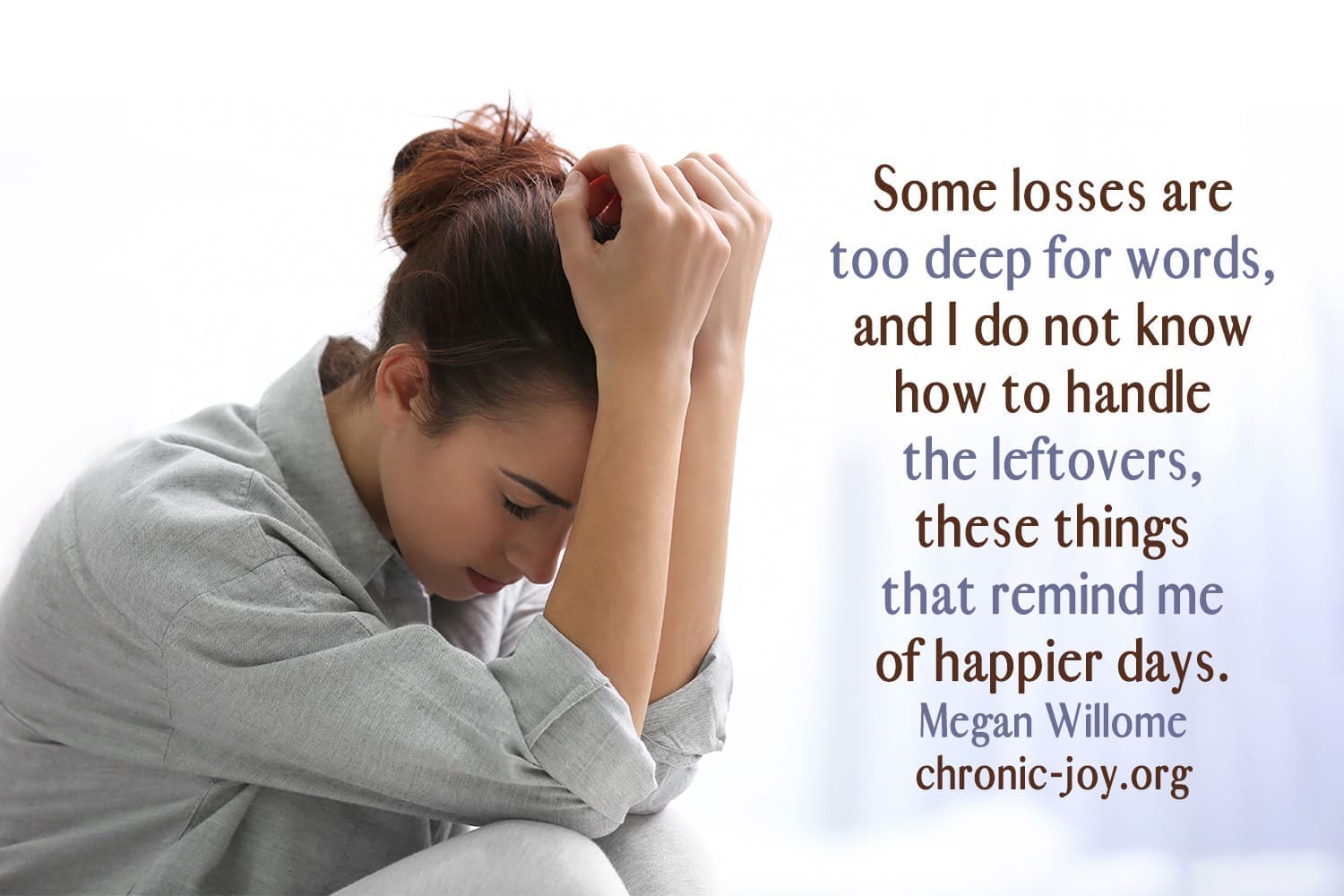
Some losses are too deep for words, and I do not know how to handle the leftovers, these things that remind me of happier days. (Megan Willome)
MEMENTOS
It’s just the ladies at Thursday morning poetry group—me and two women who lost their husbands to heart attacks within two weeks of each other. A year later, one woman still cannot bear to clean out her husband’s closet. The other is downsizing 65 years of marriage into a smaller space next door to family.
—and me? What am I to do with the photos of my lost and estranged loved ones, all the photos that hurt to look at? These mementos (the images of happy birthday parties, happy Christmas mornings, happy family vacations) wound my heart. I turn off the digital photo frame, unplug it, and resist the urge to throw it away. Instead, I thrust it into a bottom dresser drawer to sleep, as if out of sight could render out of mind. It doesn’t work.
ASLEEP
The child is not dead but asleep. (Mark 5:39)
The raising of Jairus’ daughter has always held a special place in our hearts because my husband once worked at a nonprofit called Talitha Koum. Talitha Koum are the words Jesus spoke to the little girl when he took her by the hand and bade her to rise—not from death, Jesus says, but from sleep.
Jairus has already been told his daughter is dead. People have seen her lifeless body. Now he is back at the house, and there she lies—and there is her mother, who is unnamed but mentioned. What was she doing while she sat beside the body of her child, waiting for the messenger to return?
I imagine myself in her place. If I were her, I would spend those minutes and hours wrestling with memories, especially the good ones:
- the song we cued up and belted out on every family road trip.
- our favorite movie, enjoyed with root beer and four different types of pizza.
- the handmade Valentine’s Day cards.
Some losses are too deep for words, and I do not know how to handle the leftovers, these things that remind me of happier days.
I can’t seem to pray. I should grab my Bible, but I reach for my hymnal instead.
TRANSFIGURATION
The hymn Transfigure Us, O Lord by Bob Hurd (arranged by Craig S. Kingbury) is only a few decades old, but it looms large in my heart. One August Sunday, a man opened the door at the back of the church, speed-walked down the center aisle, and came right up to the priest while he was giving the sermon. The man wore an old T-shirt and shorts short enough to offer no concealment for a weapon if there had been one. A police officer slipped out the side door and called for assistance. I later learned the man had stopped his truck in the center of the road without parking.
The man said something to the priest, who listened briefly, then gestured for the man to sit in the front row. The man sat, and the priest preached on—didn’t miss a beat. Afterward, he sat beside the man and listened while we sang “Transfigure Us, O Lord.”
The hymn describes how God, in Christ, emptied himself for those in need: the hungry, the humble, the ill, the sinner, those in darkness—all of us. I know what it’s like to feel a need so great you park poorly, wear inappropriate clothing, and barge right into church, just as you are. I have been desperate for help and only known enough to go to the house of the Lord to find it.
So, on this day when I can’t handle the good memories, I hold a hymnal and sing all four verses of “Transfigure Us, O Lord.” I can’t change anything or anyone, certainly not myself. Singing does not even transform my feelings about these mementos—but the hymn opens me.
STILL ASLEEP
Now, finally, I can pray.
Lord Jesus, what do I do with all these leftovers? I’d like to look at them again and remember, but it seems like looking at something long-dead.
Jesus: They are asleep.
Are you sure, Lord?
They are asleep.
Where?
They are with Me.
For how long?
A thousand years in your sight are like a day that has just gone by, or like a watch in the night. (Psalm 90:4)
A thousand years and a watch in the night seem very different to me.
To me, they are the same.
You are not helping. If they are only asleep, what do I do with them?
They are with Me. If you are with Me, you are with them because I am with them.
I do not immediately set up the digital frame, but I do take it out of the dresser drawer. Maybe tomorrow I’ll plug it in. Maybe someday soon I’ll turn it on.
Most of the pictures are on my phone if I scroll back far enough.
I do.
PRAYER
Oh, my Jesus, I just want to be with You. Transfigure me. Take my memories. You were there then, and You are here now. I don’t know how to hold these old happinesses. Will You hold them for me? Take them into Your heart while they sleep. Thank You for what was, what is, and what will be. Jesus, I trust in You. Amen.
QUESTIONS FOR REFLECTION
My imagined conversation with Jesus came out of a lectio divina exercise, praying through the story of Jairus and his daughter. I invite you to pray the passage now, focusing on Mark 5:21-43.
- What word in the story stands out to you? How does that word resonate with your own story?
- How would you pray if you were totally honest with God? In verses 22 and 23, Jairus held nothing back when he came to Jesus. Pray honestly to the Lord now.
- Jesus tells Jairus not to be afraid and to believe (verse 36). What is he telling you?


Megan Willome
Megan is the author of a new poetry collection Love and Other Mysteries. She's also written a memoir (The Joy of Poetry) and a picture book of form poems (Rainbow Crow). Her day is incomplete without poetry, tea, and a walk in the dark. Read her work at meganwillome.substack.com.

Lectio Divina
Lectio Divina is the ancient practice of slowly, contemplatively reading the words of Scripture, an invitation to encounter God through His Word, to pay close attention, and to be fully present.
Thank you, Megan, for giving voice to a heart-wrenching form of grief that often goes unmentioned. I deeply appreciate your Spirit-led wisdom and compassion as I deal with my own “leftovers.” May the Lord richly bless you, as you have encouraged me.
Thank you so much, Lee Ann. May the Lord richly bless you as well.